originally posted 5/7/2012. disappeared 5/15?
Literature Study
After The Thunderer (1993)
Mvt. II from Symphony on Themes of John Philip Sousa
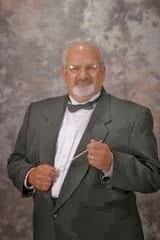
Ira Hearshen (b. 1948)
Teaching Music Through Performance in Band, Vol. IV, p. 900. Here listed as the entire Symphony on Themes of John Philip Sousa as grade 6. NBA , WRP V (out of VII), publisher V (LudwigMasters, $75.00). 7.5 minutes, ABA form, 110 measures, quarter=48.
Lowell Graham, retired conductor of The United States Air Force Band, tells the story of how Hearshen came to compose After The Thunderer. Graham and Hearshen were sitting up talking late one night when Graham suggested that Hearshen, a Hollywood arranger and orchestrator, write a suite for concert band based on themes of famous American marches.
Hearshen, who has a special passion for Mahler’s Symphony No. 3, began musing over Graham’s suggestion when he had a stroke of inspiration.
Calling Graham at 2:30 in the morning Hearshen said that he would write a slow, extended adagio in the style of the finale to the Mahler 3 but based upon themes from Sousa’s The Thunderer. Hearshen began singing the idea over the phone to Graham who says that he “immediately sat up in bed, wide awake. Ira now had my complete attention.”
So successful was After The Thunderer that Hearshen composed three more movements based on the Sousa marches, Washington Post, Fairest of the Fair, and Hands Across the Sea.
Cast in a slow ABA movement, the melody is an augmentation of the trio of The Thunderer. Tonalities pass from A-flat Major through A Minor, E-flat Major, and returning to A-flat Major. There are no difficult rhythms or technical passages. However, the Euphonium and Trombone I do have notes up to A-flat, and there is a considerable endurance challenge for Trumpet I in the upper register.
Several YouTube videos are available for viewing and comparing interpretations. By all means compare After The Thunderer to the Finale of Mahler’s Symphony No. 3. I don’t think a legitimate interpretation of the Hershean can exist without taking the Mahler into consideration.
Regarding suitablity for OSW, The writing progresses well from beginning to end. There are no exposed passages for 2nd or 3rd part players, but solo passages for bassoon, oboe, and trombone require mature players with beautiful tone, and control and endurance for the 1st trumpet. I believe that OSW could perform the piece with our limited rehearsal schedule, and that many of our players would find the music rewarding.
Showing posts with label Literature Study. Show all posts
Showing posts with label Literature Study. Show all posts
Monday, May 7, 2012


Monday, April 23, 2012
Lit Study - Blue Shades by FrankTicheli
Literature Study
Blue Shades (1996)
Frank Ticheli (b. 1958)
Teaching Music through Performance in Band, Vol. 2, p. 547. Here listed as a grade 6. NBA 5, WRP VI (out of VII), publisher, 5. 11 minutes. ABA form, 430 meaures.
Frank Ticheli is Professor of Composition at the University of Southern California. He earned degrees in composition from Southern Methodist University and the University of Michigan. Among his composition teachers are: William Albright, George Wilson, Leslie Bassett and William Bolcom.
Ticheli writes band music in many grades of difficulty, and I first learned of him through “Fortress” for grade 3 bands, and then the widely-played “Cajun Folk Songs.” “Blue Shades” was commissioned by a consortium of universities and high schools, and contains several jazz/blues styles throughout. The slower middle section features the clarinet in a bluesy/torch song style, occasionally sultry and then “dirty.” Some of the closing section reminds me of the hard driving super heroes movie themes like "The Incredibles."
“Blue Shades” has featured solos for clarinet, bass clarinet, and oboe. Only the clarinet, during the slow center section, has notes in an extreme range. Among the jazz techniques utilized in the piece are pitch bending, flutter tonguing, and straight vs. swing eighth notes. Ticheli uses compositional techniques of hemiola (duple feeling in triple meter), cross rhythms, and syncopation.
Harmonically, Ticheli uses no actual blues progressions, but freely incorporates blues notes of flatted 3rds, 5ths, and 7ths, and pentatonic scales. The work is pitched in G with both major and minor modes.
This is an exciting work and musically satisfying to rehearse and perform. The piece is complicated enough to require significant rehearsal, and so, doesn’t appear to be accessible for OSW at this time. So, “Blue Shades” goes on the shelf for a while.
Blue Shades (1996)
Frank Ticheli (b. 1958)
Teaching Music through Performance in Band, Vol. 2, p. 547. Here listed as a grade 6. NBA 5, WRP VI (out of VII), publisher, 5. 11 minutes. ABA form, 430 meaures.
Frank Ticheli is Professor of Composition at the University of Southern California. He earned degrees in composition from Southern Methodist University and the University of Michigan. Among his composition teachers are: William Albright, George Wilson, Leslie Bassett and William Bolcom.
Ticheli writes band music in many grades of difficulty, and I first learned of him through “Fortress” for grade 3 bands, and then the widely-played “Cajun Folk Songs.” “Blue Shades” was commissioned by a consortium of universities and high schools, and contains several jazz/blues styles throughout. The slower middle section features the clarinet in a bluesy/torch song style, occasionally sultry and then “dirty.” Some of the closing section reminds me of the hard driving super heroes movie themes like "The Incredibles."
“Blue Shades” has featured solos for clarinet, bass clarinet, and oboe. Only the clarinet, during the slow center section, has notes in an extreme range. Among the jazz techniques utilized in the piece are pitch bending, flutter tonguing, and straight vs. swing eighth notes. Ticheli uses compositional techniques of hemiola (duple feeling in triple meter), cross rhythms, and syncopation.
Harmonically, Ticheli uses no actual blues progressions, but freely incorporates blues notes of flatted 3rds, 5ths, and 7ths, and pentatonic scales. The work is pitched in G with both major and minor modes.
This is an exciting work and musically satisfying to rehearse and perform. The piece is complicated enough to require significant rehearsal, and so, doesn’t appear to be accessible for OSW at this time. So, “Blue Shades” goes on the shelf for a while.
Subscribe to:
Posts (Atom)